An Interview with Dr. Eberhardt Sarfert
Head of BMW Motorrad, 1979-1989
by Bob Stokstad, BMW MOA no. 128676
BMW Owners News
February, 2007
When the next history of BMW Motorrad is written it will describe a success story, of course - one to which many individuals will have made significant contributions. The events that happened during the decade that Dr. Eberhardt Sarfert led BMW Motorrad will figure prominently in the tale because they were fundamental in the redirection of the two-wheeled division's technical and marketing efforts and laid groundwork for today's vibrant and profitable motorcycle division. It was during this period, the eighties, that both the GS and the K-series were introduced, the oil-head (four-valve) boxer was developed, and the F-series was conceived.
Retired since 1990, Eberhardt Sarfert and his wife Heidrun live on their farm near Landshut, Germany, not far from Munich and BMW's headquarters. He has ridden motorcycles all his life and continues to be an acute observer of the motorcycling scene as well as a passionate rider. A fellow rider and acquaintance of fifteen years, Bob Stokstad of Berkeley, California, recently had an opportunity to ask Dr. Sarfert about his motorcycling career.
When and how did you begin with motorcycling? Were you the first in your family to ride?
It was 1955 - I was 18 years old. I got a license and then, right away, a motorcycle. From there on I went on to high school, university and, until I began to work, always had a motorcycle. I wasn't the first in my family, though. I have an older brother who already had a motorcycle. We lived in the country. There were cars then, to be sure, but not many for young people and motorcycles were a means of transportation.
What kind of motorcycle was it?
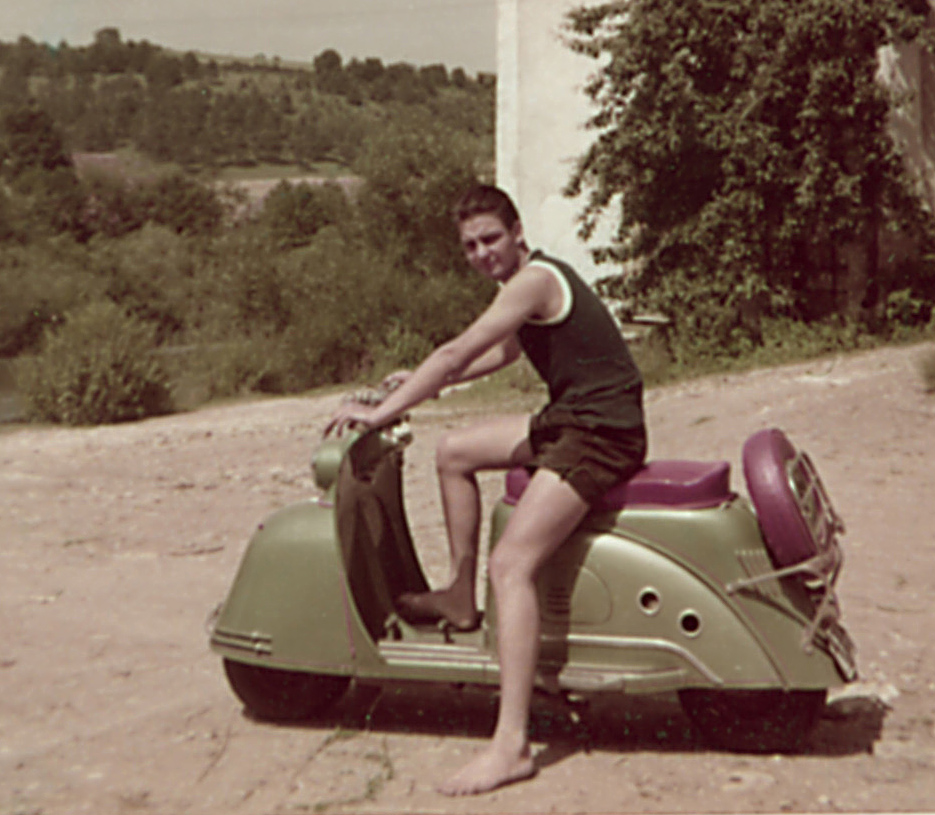
I first had a Goggo motorscooter. It had 200 cc and an electric starter. The electric start was something quite special for that time.
Was it new or used?
Eighteen years old and riding a 1955 Goggo Motorscooter.
photo: E. Sarfert
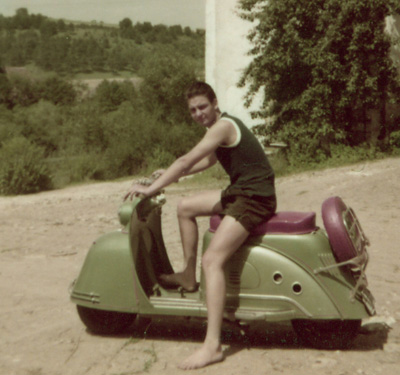 |
It was new. It was built by the Glas Company in Dingolfing, which later built small autos and afterward was bought by BMW. Next I had a DKW 125 cc RT, then an NSU 175 LT. I graduated from high school in 1957 and rode a motorcycle until shortly before I got married in 1963.
Did you work on these bikes yourself, tinker with them, make repairs, more or less?
Less rather than more. Of course, we tinkered with them. Tires were bad then and we were always fixing things. But I didn't make serious repairs, and I wasn't able to, really.
What did you do when you begin working for BMW?
I started working in the Personnel department
Was your law degree important for that job?
I had applied for a position in the legal department, but there wasn't anything open then. They said they needed someone to handle personnel cases, so I said fine and started working in January, 1966.
Could you sketch your career path at BWM?
Yes. It was, actually, quite a sensation. I started out working on individual cases in Personnel and, about every eighteen months, got promoted until, in 1972, I became the Head of Personnel. During that time I also completed all the requirements for a law degree.
During this time were you riding a BMW that you'd bought?
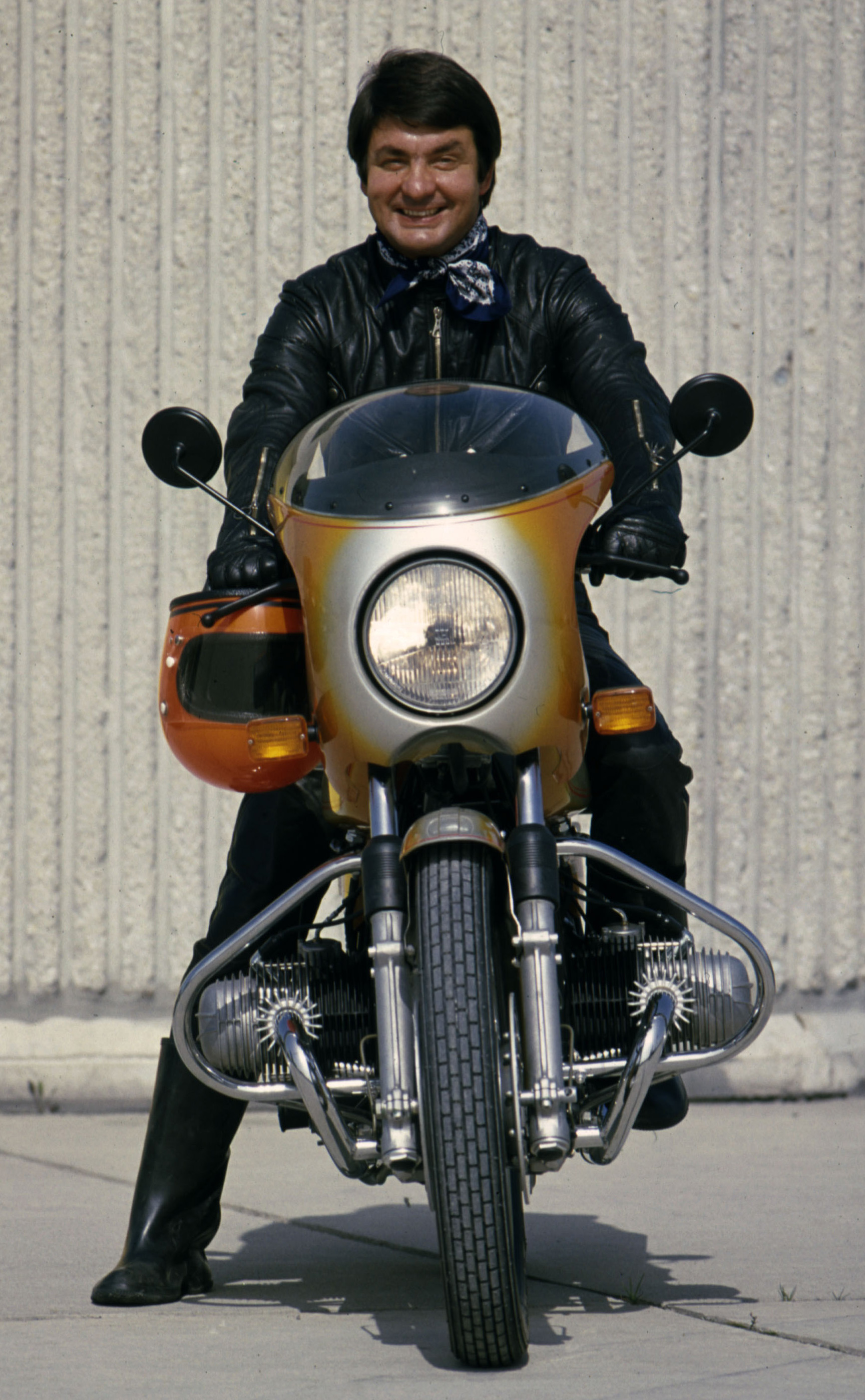
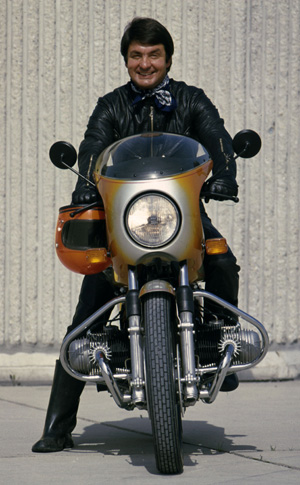
No, I always had a BMW to ride but at first they were "lent" to me by the company. Later on I bought them. At that time I had an R60 with the triangular front fork, or "Vollschwinge."
1974 - on a R90S (photo: BMW archive)
 |
How did you get involved in the motorcycle part of BMW?
Well, I'd always been riding a motorcycle while working at BMW and continued riding while I was Head of Personnel. It was kind of unusual and conspicuous for a person in that high a position to ride a motorcycle regularly, to go on rides with BMW employees, participate in test rides, and so on. In 1979 BMW Motorrad was pretty much at the end, one could say, and the leadership of BMW was considering whether to end motorcycle production. They seemed more in favor of stopping because automobiles were the overwhelmingly large part of their business and motorcycles were insignificant. The image of the motorcycle was enormous, however. A survey made at that time showed that, even though motorcycle production was only three percent of the total, twenty-five percent of people surveyed thought that more BMW motorcycles were made than cars. And in the USA, then, people recognized BMW only as a motorcycle manufacturer, not as an automobile producer - the cars were insignificant as far as image was concerned. Beyond image, there was a crucial political factor then, namely that BMW motorcycles were manufactured in West Berlin. This provided both jobs for West Berliners and a visible statement of the importance of this city, which at that time was surrounded by the Wall. For all these reasons, BMW didn't want to give up producing motorcycles.
So, top management said, we can't keep on with the motorcycle effort being led by a number of lower level managers, it needs a single leader at a higher level. They said, 'Sarfert, you are on the governing board, you are the youngest, and you ride a motorcycle, so you do it.' I was willing to risk my professional future with BMW by tying it to the success of BMW Motorrad. So I said I'd do it. That's how it happened, really quite simple. They decided to raise the importance and image of the motorcycle by having its leadership at a higher level within the company, which at the time was almost exclusively oriented toward the automobile business.
Which motorcycles was BMW selling when you took over the motorcycle division?
That was then a very sad, discomforting situation. The little 250 cc single cylinder had ended production in '67. There were the 500, 600 and 750 cc machines, all boxers. And the R90S was just coming out - the gold-painted model, a beautiful bike. But this just wasn't sufficient. The motors were ancient. And, I have to say, the Japanese were going full-bore. We simply looked old, and BMW Motorrad, if it was going to be an image for the automobile sector, couldn't afford to have such an old technology. So, we said, there has to be a new one.
Well, this had also been said three years earlier. A new management team had been brought on board, and they were developing an in-line three cylinder motor with 1000 cc. The design was similar to what became the K-series. This was supposed to be the single model that would replace the boxer. That's what was planned and a new production facility and assembly line had been built in Berlin just for the new motor and bike. Then another market survey was made and it predicted this model would be a flop. BMW can't replace the boxer with a three-cylinder model. If it's going to be replaced, it has to be with a technology at least equivalent to that of the Japanese. So, the planned K assembly line in Berlin didn't go into production, which was a big financial problem at the time. It was switched over to make automobile parts while we decided what to do about the next motorcycle. The decision was to bring out the K-series based on a 1000 cc four cylinder motor and including a 750 cc three-cylinder model.
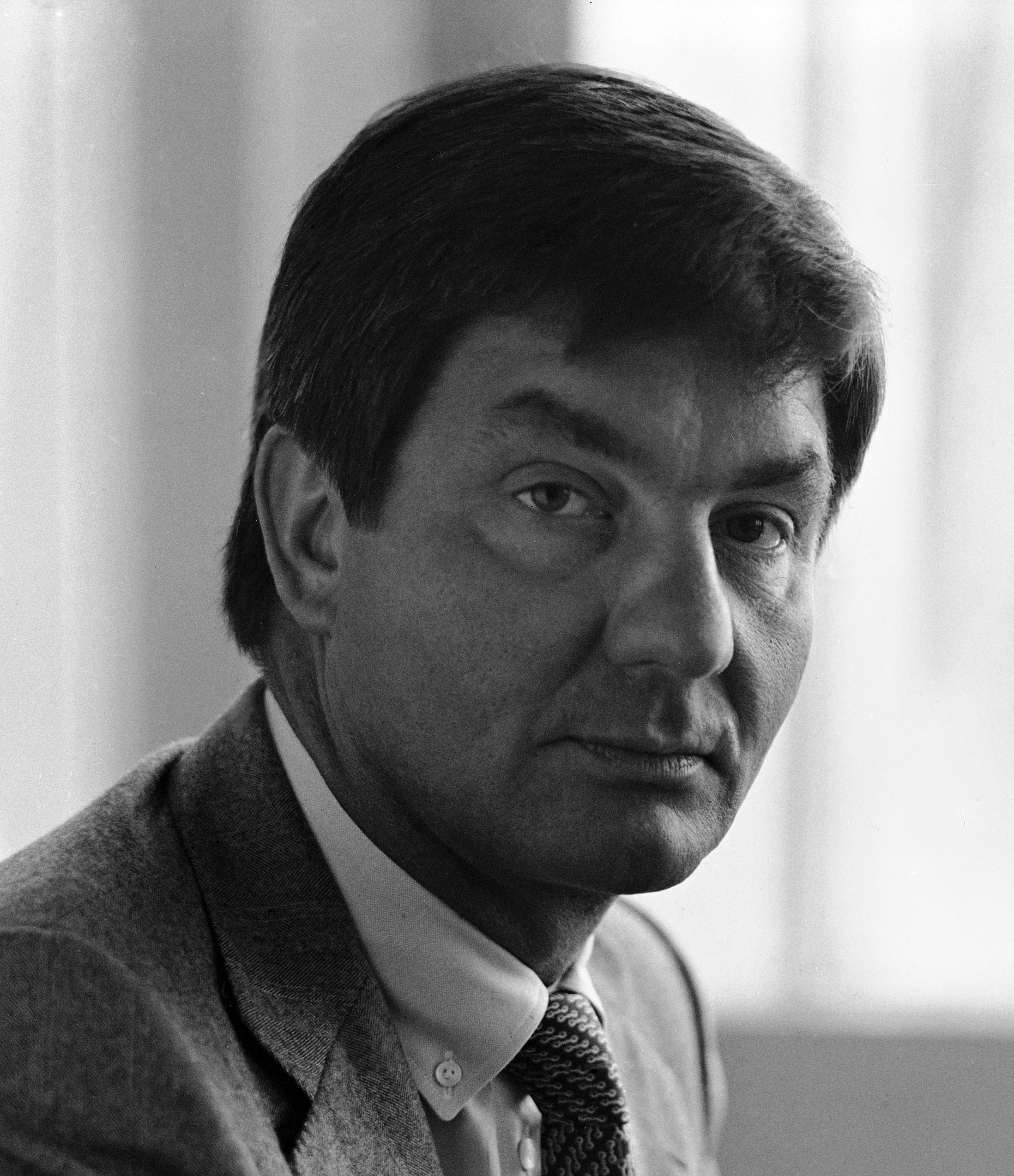
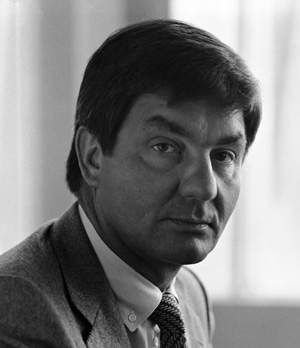
1980 - Head of BMW Motorrad (photo: BMW archive)
 |
Furthermore we decided that the boxer had to be kept going. We called this our "dual strategy" – to develop the new K-series as our star for the future but keep the boxer going to carry along the image of BMW. We would, on one hand, bring out the new K and, on the other hand, modernize the boxer within its constraints, which you well know. And so we introduced the "G/S." That was an area, motocross, in which there were bikes up to 500 cc. We felt if there would be a class for motors over 500cc, that's where we could jump in. That's when we decided to develop the 800 GS, based on the 750 cc motor. So that's how the modernization of the boxer line began, through the introduction of the GS line beginning with the GS 800 cc.
And the GS was a big success, wasn't it?
Yes, a very big success and especially from the standpoint of BMW's image.
Was it at this point that you started competing in Paris-Dakar?
Yes and it was all very expensive. But it was an image statement, 'BMW is here again' and this was especially important as a basis for the introduction of the K-model. We didn't want to go from nothing (the old boxer models) directly to the new K without first attaining a higher level.
What was the timing of that, with respect to your heading the motorcycle division.
I started in '79 and the first K model came out in '83
What other developments were going on at the time?
The question was, then, what to do with the boxer? We'd pushed the development of that motor hard, sprucing it up in every possible way - we brought out the 1000cc model. At some point the technical people said, 'that's it, this is the end.' The Japanese were routinely getting 100 horsepower out of 1000cc. You could try anything you want, but it just wouldn't be possible to get more than 70 horsepower out of the old boxer design and still have the reliability required for a production motorcycle.
It was clear we wanted to keep the boxer, since we'd started BMW with that motor, so it became equally clear that we had to have a new boxer. It was toward the end of my time at BMW when I convinced management to approve the development of the new boxer. Economically, however, it was on the borderline. That is, the development costs were so high and the anticipated sales for motorcycles so modest as to make it a difficult decision to go ahead. The estimated profits were not that high for BMW's standards.
That's how it looked?
Yes, even though it turned out differently, that's how it looked to us at the time.
When did the new boxers come on the market?
Well, that was after my time at BMW. I left on December 31, 1989 and the new Boxers came out in '91 or '92, I think. But the development of the whole package was complete at the time I retired. I saw and heard the new motors running at that time.
Was it a surprise that the new boxers did so well after their introduction?
For me it wasn't a surprise because I believed in it. Otherwise, it never would have made it through. But some of my colleagues and the automobile people had raised eyebrows when it all went so well, I must say. They were pleasantly surprised that, first, the motor was so good and, second, that the boxer fans were so many and when a new boxer technology was offered, they bought it, and still do today.
It turned out that the new Boxer is out-living the K-series.
What we thought would be just an image and provide only supplemental income to the main K series turned out to be much more profitable. And today it's not just an image maker, it's the main part of BMW's motorcycle product line.
As the head of BMW Motorrad, you must have had to travel a lot. Did you travel often to the US?
At that time in the US, the importing and distribution of motorcycles wasn't providing what we wanted, so we ended our relationship with that importer and started our own importation and distribution. That was in '83-'84. As a result I traveled frequently to the US, to dealer exhibitions, for organized rides, and especially for the introduction of new models. It was great. I really enjoyed this. I also came to the US for some discussions with Harley Davidson as we were thinking about collaborating with them. That never came to anything as both firms decided it wasn't in their interest.
How many motorcycles do you have now and why these particular ones?
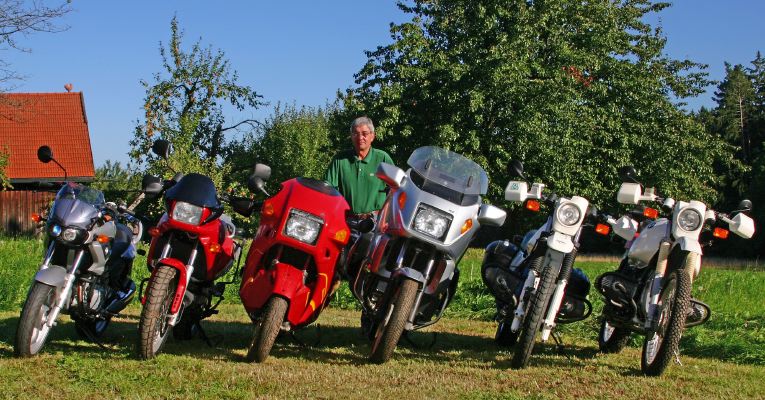
I have six BMW motorcycles here at home. These are all models that during my time at BMW Motorrad came out on the market, were developed, or were in the planning stage. That is, these are the motorcycles to which I have some connection and that I ride. And these particular motorcycles have only been ridden by me.
The oldest is a 1981 R80 G/S - reportedly, the first off the assembly line. It's original in all aspects. I also have what is reputed to be the last boxer off the assembly line, the R80 BASIC, a 1996 model that was offered to me after I left BMW. In addition to these two-cylinder machines, I have a three-cylinder model, the K75 LT, or touring model and the four-cylinder bike is a K1. The two newest bikes I have are the single cylinder models. First, a 650F. (BMW started the design for the F series, and I initiated the contacts with Rotax for the motor and Aprillia for the frame and assembly.) And second, I have a newer single cylinder, the 650CS.
Eberhardt Sarfert's motorcycles. l. to r. '05 650 CS, '95 650F, '89 K1, '96 K75 LT, '96 R80 GS-Basic, '81 R80 GS
(photo: R. Stokstad)
 |
No new boxer?
That's right, no new boxer, at least not now. I did own a four-valve earlier, of course. But then, as I got older, I felt more comfortable on the old boxer because of its lighter weight. This was the start of my "down sizing." Also, my heart was always with the old boxer - that's an emotional matter. And of the boxers, my favorite has been the GS, both the R80 and the more powerful R100.
The technical personnel at BMW are concerned with performance and reliability, and the designers with how the motorcycle looks. How well do they get along with each other, or not?
That changed with time. From early on, and still at the time I started with BMW Motorrad, development and design were driven mainly by technical and not by marketing considerations. In the '60s, however, as the role of the motorcycle began to change from essential mode of transportation to recreational vehicle, looks began to become more important, until now the visual design - the image - dominates technical aspects.
In the '70s motorcycle marketing was handled by the automobile division. In fact, practically everything having to do with motorcycles was done by people in various automobile departments devoting part time to motorcycles. There was no real independent motorcycle division. When I was approached about taking charge, I said, 'if so, then all.' I wanted a separate motorcycle division, one in which technical development, design, production, administration - in other words, everything - was included. And one in which the people worked only on motorcycles. This was the founding of the present motorcycle division at BMW.
Marketing impacts or even determines how a motorcycle looks. In fact, now, that seems to be the most important thing.
That's true, but the technical design and the quality have to be up to BMW standards.
So, what about the Cruiser?
We discussed bringing out a cruiser during my time. The four cylinder K motor wasn't right for a cruiser. It wasn't the low-revving, torquey engine a cruiser requires. For this, the boxer was better, but it had the fundamental problem that the protruding cylinder heads get in the way of the classic cruiser riding position, in which the legs are extended way forward. For these reasons, I was against proceeding with the cruiser, even though BMW was, in a sense, ready for this development and would have gone along with it. My successors felt differently, that we wanted a cruiser, we needed a cruiser and, since the K wasn't suitable, we would use the boxer, which by then was the four-valve engine. The Cruiser design around the boxer motor was beautiful, but in the end it wasn't a big success.
You've ridden many miles in the course of your career. Has it always been rubber side down? Speaking for myself, I know that every couple of years I have a get-off and that it's just a part of riding. How about you?
OK, little crashes happen all the time. That's just falling off. I've had two accidents that put me in the hospital. One was here, close to home. There was absolutely nothing I could do. I had the right of way. He (the car) couldn't see me, and I couldn't see him until it was too late.
I had an accident in Austria, in a tunnel. And this time it was my fault. It was raining hard and I had a new helmet. When I entered the tunnel, I tried to raise the visor, which had become fogged. While fiddling with it, I saw I had entered the oncoming lane, and a car was approaching. I laid the bike down and my helmet and hip hit the wall. Thank God there was no collision with the car, but still I spent ten days in the hospital.
You still ride. What are you looking forward to in motorcycling - I mean your personal riding - how do you see that developing?
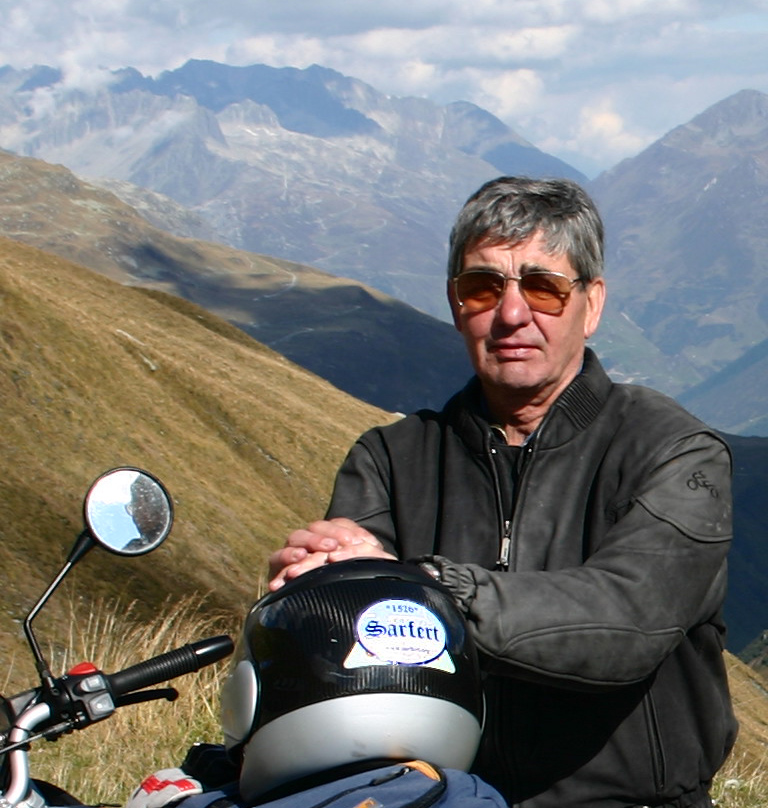
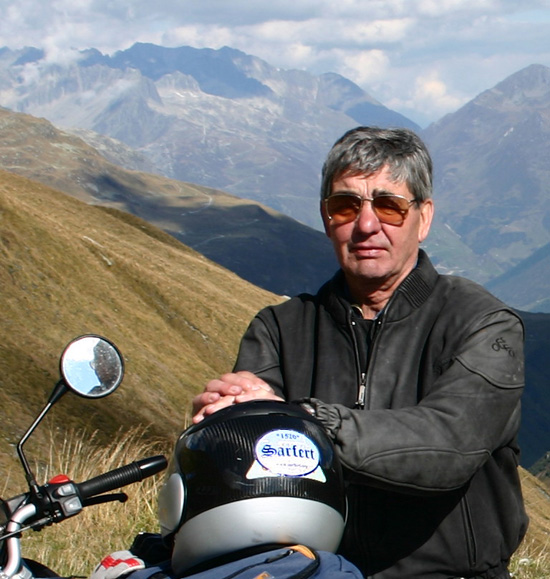
With the 650CS in Austria, 2005 (photo: R. Stokstad)
 |
Yes, I think I can predict this. There are two kinds of motorcycling for me. The first kind is what I'll call 'fetching the newspaper.' It's riding around Landshut and environs, doing small errands, visiting friends - call it 'commuting.' The same things you would use a car or bicycle for. I see myself doing this for a long time in the future. The other kind is touring. Every year we do a long tour, with friends. That's a very different experience - beautiful scenery, arriving at the destination, greeting old friends, 'wining and dining,' experiencing something new or different, riding all day long. That's a different world, and actually the one you think of when talking about motorcycling. Now that I'm getting older, I like a smaller motorcycle, one that I can handle more easily. By choosing right, including the destination (not where it rains all the time or is otherwise unpleasant) I can extend the time that I can continue to do longer tours. Tastes change as one gets older, too. The quality of the hotel and the food becomes a little more important. Yes, I'm looking forward to riding and touring for some years to come.
Dr. Sarfert - thank you very much for sharing your recollections and thoughts on motorcycling. It was a fascinating time that you described and I wish you many more years of motorcycling.